 Community Magazine
Before and After Samos: The Greek Joomla Community Brings Open Source to the University of the Aegean, Interview of Bill Kotsias
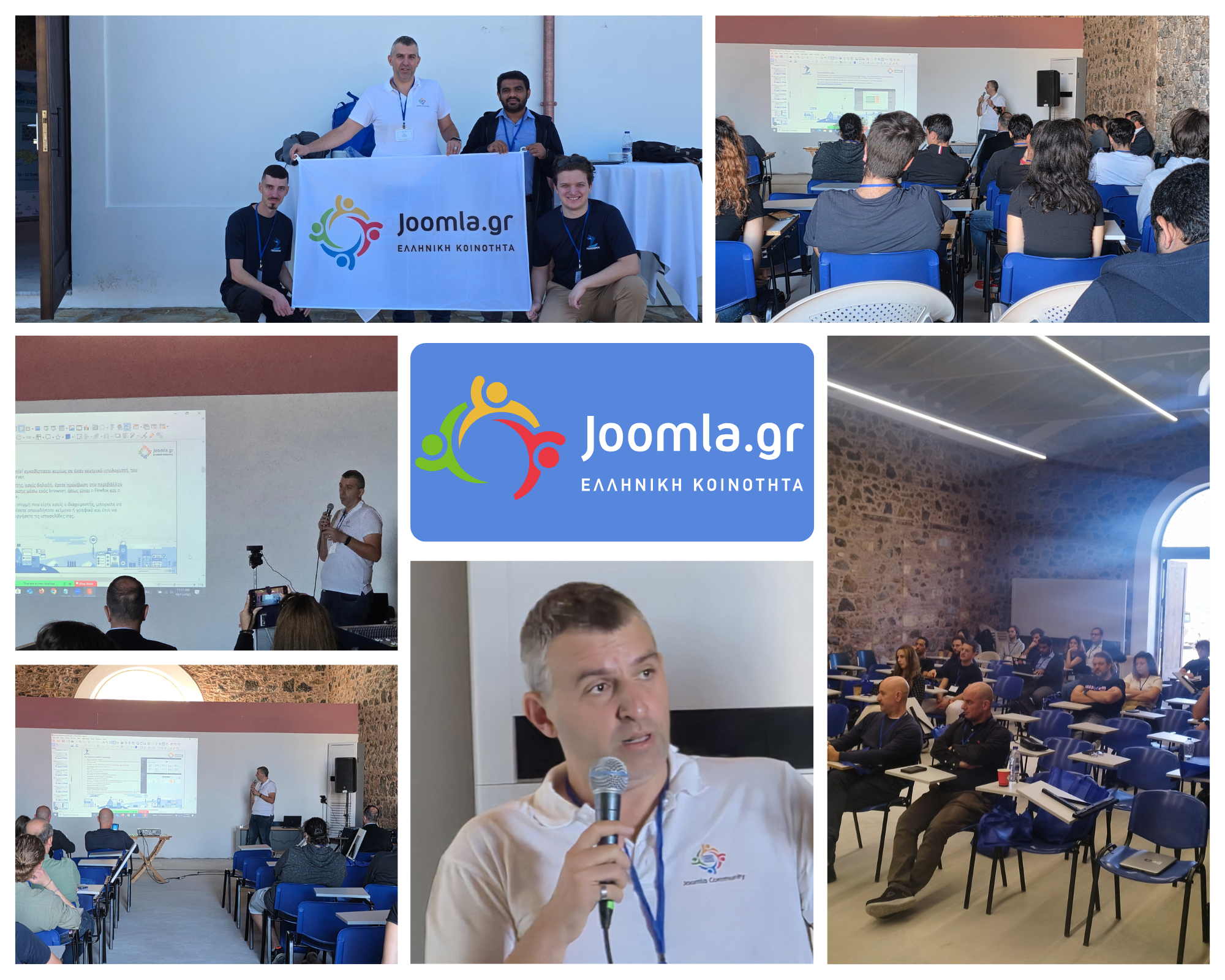
In October 2025, members of the Greek Joomla community, led by Bill Kotsias, were invited to speak at the University of the Aegean in Samos. Their goal: to introduce Joomla — one of the leading open-source CMS platforms — to students and educators in Greece.
To capture both the anticipation and the outcomes of this event, we decided to conduct this interview in two parts — before and after the presentation — to learn more about the vision, the energy, and the impact of this initiative on the local Joomla ecosystem.
Before the Event (Pre-Interview)
Hello Bill, could you tell us more about you ?
My name is Bill Kotsias and I am the founder of the company E-base.gr, which deals exclusively with the construction of websites with Joomla and the hosting of websites optimized for Joomla. My involvement with Joomla began in 2007, during the transition from Mambo to Joomla. As soon as I started using it and saw its potential, I immediately fell in love with it. My first thought was that I wanted to use it professionally for all my clients. Gradually, I created a business based entirely on Joomla. We began building websites and web applications for small, medium, and large companies. From then until today, we don’t take on any work that isn’t Joomla-related. We constantly promote the software and encourage others to use it as well.
Bill, how did the idea for this presentation at the University of the Aegean come about?
The idea started through FOSCCOMM, a conference held every year at different universities by students or professionals. It’s an event where theories are applied in practice through workshops and presentations. Each year, we present the capabilities of Joomla through an introductory session or workshop.
What motivated the Greek Joomla community to take part in this university event?
What motivates the community each year is our consistent participation in the FOSCCOMM conference, regardless of which city it takes place in. We present the key features of Joomla, the new capabilities, and the upcoming versions, either through workshops or talks. Essentially, it’s an annual meeting where we showcase Joomla’s steady progress and evolution.
How did the collaboration with the university and the organizers start?
The collaboration didn’t start directly with the Greek community but through FOSCCOMM. The organizers, usually students, coordinate the space at the university and host the event. Each year, the conference takes place in a different city, and that’s how our cooperation with each university comes about.
What will be the main topics covered during your presentation?
The presentation will focus on the basic principles of Joomla, how it works, what its capabilities are, and how it can be used by the audience. It’s essentially a “Basic Instruction” session that demonstrates what Joomla does, where someone can start, and how far they can go with it.
Who is your target audience — computer science students, professors, or a broader public interested in web development?
The audience is mainly composed of computer science students and professors, about 70% and the remaining 30% are general attendees interested in the internet, either professionally or as users. Joomla is extremely easy to use and offers endless possibilities, so interest extends far beyond just the IT community.
What key message would you like the audience to take away from your session?
The message is that Joomla is a top-tier, free software for building websites and web applications. It’s accessible to everyone and can be used for any type of project, from a small site to a large, demanding one. We want to show that Joomla is now very easy to use. With just four simple steps, anyone can create a functional and visually appealing website without needing programming skills. In the past, it was more difficult, but today Joomla is simple, fast, and modern.
Could you tell us more about the Greek Joomla community — its size, activities, and overall spirit?
The Greek Joomla Community was founded in 2005 and is made up of members who each have their own business but also volunteer their time to support and promote the software. At every conference or IT-related event, we aim to showcase Joomla and its capabilities. The community is also active in translation. Members themselves handle the localization of Joomla into Greek. We have created stands, banners, and flyers at our own expense and participate in exhibitions and conferences to spread awareness of Joomla. Everything is done independently, voluntarily, and with great enthusiasm.
What place does Joomla hold today in the Greek web ecosystem?
In recent years, there has been a significant effort to expand Joomla’s presence in Greece. Today, it is estimated to power about 30% to 40% of Greek websites compared to other platforms. This growth became much more noticeable after the release of Joomla 4, as people realized they could build visually appealing and secure websites. Joomla’s biggest advantage is security, something both professionals and clients highly appreciate. That’s the main reason many choose it over other systems.
Have you noticed a renewed interest in open-source CMS platforms in recent years?
In general, I haven’t noticed a major increase in interest for open-source software overall. However, I have seen a significant shift specifically toward Joomla, because it’s fast, flexible, secure, and allows for the creation of limitless web applications. With Joomla’s open code, you can literally build anything.
What are your personal hopes for this event in Samos?
Our expectation is to inform the audience about Joomla’s capabilities and to show that with just four simple steps, anyone can create a complete website or a modern web application in less than ten minutes. During the presentation, we will demonstrate practical examples that show how Joomla can be used for modern, real-world needs, from booking systems and online payments to CRM management and any other function a professional might require. Above all, we want to highlight Joomla’s maximum level of security, which is almost absolute and remains one of its strongest assets.
If everything goes as planned, what would you consider the greatest success of the day?
The greatest success would be if the audience, after listening to the presentation, tried, even experimentally, to create a Joomla site using the free tools available. If participants are motivated to explore Joomla hands-on, that would mean we’ve achieved our goal. After all, the word “Joomla” in Swahili means “all together”, and that’s exactly the spirit we want to communicate: if everyone contributes even a little, the community will grow, and Joomla will spread everywhere.
After the Event (Post-Interview)
Bill, how did the day in Samos go?
The day in Samos was very pleasant and constructive! A conference took place with a large turnout and strong public interest in Joomla.
What was your first impression once you met the audience?
My first impression was very encouraging, as the audience was actively engaged and seemed to have a basic knowledge of Joomla. During the lecture and the analyses we presented, the audience became excited as they discovered parts of the software they hadn’t known before. They showed great interest in getting more deeply involved with Joomla.
How would you describe the atmosphere and the participants’ reactions during the presentations?
The atmosphere was very warm. The attendees showed strong interest, many were constantly taking photos of the presentation slides so they could review them later. There was particular interest in the technical aspects of Joomla, especially in its security features and the simplicity of installation in four steps. The audience was impressed by how quickly one can have a fully functional website.
Which subjects or demonstrations generated the most interest or questions?
The subjects that drew the most attention were mainly Joomla’s security and the structure of its code that ensures the quality of the final result displayed to visitors. People were also impressed by the fact that installation can be done without additional extensions and with no extra cost, something many didn’t realize before. At the end, the main questions were about what determines Joomla’s high level of security, how its code functions, what advantages it has compared to WordPress, and what makes it different overall. When the “Joomla or WordPress?” question was addressed, the audience clearly understood when to choose Joomla over WordPress.
Did you have any memorable exchanges with students or professors?
The most memorable experience was the congratulations we received from the Headmaster of the University at the end of the lecture, as well as the enthusiasm of the students for programming and volunteering within the Joomla community, not only in the Greek branch but also at a global level.
Would you say Joomla offers good opportunities for young developers to contribute to open source? Why?
Yes, of course, perhaps all programmers should start there, since this particular software offers structured code where anyone can create a unique, secure, and quality site.
Is there a highlight or anecdote from the event you’d like to share?
I would like to mention again the topic of security. It was clearly visible in the audience’s reactions how impressed they were by Joomla’s level of security and by the fact that no additional extensions are needed to create a website. Up until that point, many believed Joomla was just another CMS requiring a significant budget to produce a decent site. After this event, many changed their perception.
What follow-up actions are planned after this event?
At the moment, there isn’t a specific plan already organized. We’re waiting for an institution, university, or company to invite us to present Joomla again within the context of CMS and web technologies. Our proposal to the international community is to organize a European conference where we, as the Greek Community, could participate and present our position.
Have you already noticed any impact — such as new contacts, collaborations, or student projects related to Joomla?
There are no concrete results yet. However, during the networking session at the end of the event, there was notable interest from both students and speakers in the Greek Joomla Community.
How has this event strengthened the Greek Joomla community’s visibility or motivation?
The event significantly increased our visibility. The analysis presented helped people become more familiar with Joomla and turn their attention toward the Greek Community. It also served as motivation for more people to join the community, something we truly hope will happen in the near future.
What do you see as the next big step for the Greek Joomla community?
We discussed how we could contribute both theoretically and practically to the Global Joomla community and there was also curiosity about exploring it through collaboration. We would be very eager to participate in a Global Joomla event and represent the developers of our country on an international stage.
Would you like to share a message with the international Joomla community following this experience?
Yes, the message we’d like to share with the international community has two parts. First, we hope a global conference will be organized where we, as the Greek Community, can participate. Second, we would like to see the return of Joomla Administrator Certifications, as they existed during Joomla 3. This would allow all professionals in Greece — both community members and non-members — to obtain official certification. That certification would make it easier for them to promote Joomla to new clients and businesses. Our proposal is that, once a year, under the guidance of the international community, official Joomla Admin certification exams should take place — corresponding to the current versions, such as the upcoming Joomla 6.
Thanks to all the attendees :
Greek Community's website: www.joomla.gr
Bill Kotsias's website: www.e-base.gr
George Fakas's website: www.easylogic.gr
Dimitris Trikkas's website: www.redtie.digital
Some articles published on the Joomla Community Magazine represent the personal opinion or experience of the Author on the specific topic and might not be aligned to the official position of the Joomla Project
About the author
By accepting you will be accessing a service provided by a third-party external to https://magazine.joomla.org/
Comments