 Community Magazine
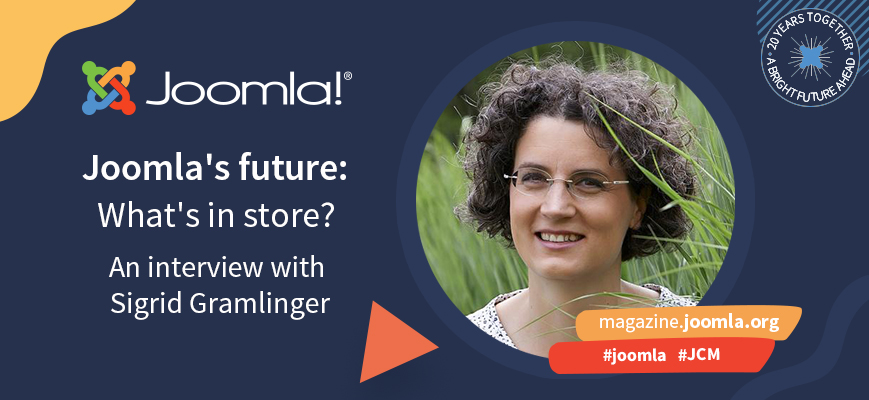
Since 2023, Sigrid Gramlinger has been the Coordinator of Joomla's Production Department. She just got re-elected for another term. In this interview, Sigrid tells us more about her department, the responsibilities, the achievements and the strategy for the future.
First of all: thanks for stepping forward for this role and congratulations on being elected!
Thank you so much! When the community keeps trusting you, it would feel wrong not to show up. So here I am - third term, slightly more grey hair, same amount of enthusiasm.
Could you tell us a little bit about yourself?
I'm Sigrid, based near Vienna, Austria. I studied business education, then worked on ERP systems in Hamburg before going self-employed in 2004. Since 2010 it's been Joomla exclusively - through my agency webgras.at, where we build and maintain websites for SMEs, associations, and organisations. I hold certifications in digital consulting, eCommerce, IT security, and web accessibility. I've been speaking at Joomla events since 2015, co-founded the Joomla User Group Vienna and helped kick off the first JoomlaDay Austria. Outside Joomla, AI is currently a huge topic in my own agency workflows - even if my clients aren't quite there yet.
You're Coordinator of Joomla's Production Department. That is where the magic happens, right?
Exactly - all the magic, and also the bugs. Production oversees everything related to Joomla's code and software: developing and releasing the CMS, translating it, testing it, documenting it, keeping it secure. This includes automated updates and signed releases - so you know what you're installing is genuine and hasn't been tampered with. Every release that lands on your server comes through our production teams. We don't just ship code - we make sure the whole pipeline works, from first commit to "update available" - now even "automagically"!
What is the most common misconception about Production?
That it's purely a developer thing. Yes, we have incredibly talented developers - but Production also needs testers, writers, translators, and people who are good at structure and communication. Some of our valuable contributors don't write a single line of PHP. If you can write clearly, think systematically, or speak another language fluently, Production has a place for you.
What teams are part of your department?
The CMS Release Team, the Testing Team, the Translation Teams, the Documentation Team, the Security Strike Team, and the Automated Testing Team, among others. It's a rich ecosystem of people who care deeply about quality and continuity. Here is our team list: volunteers.joomla.org/departments/production#teams
Do your teams need people and if so, in what capacities?
Always - and I want to be direct here: the Bug Squad is really understaffed right now. If you use Joomla and have even a little time to spare, this is where your help is needed most urgently. We also need testers for releases and PRs, documentation contributors who can explain things clearly to both beginners and developers, and translators.
You've served on the Board of Open Source Matters as Production DC since 2023. What do you like about the role?
I'm now the longest-serving board member in the current lineup - which, depending on the day, feels either like an achievement or like I've been voluntarily marooned on a very interesting island. What I am doing well (I think) is being a steady presence: someone who knows the history, holds the threads together, and helps the board navigate complex decisions. I like building structures that outlast any single term. And I'm not the person who shouts the loudest - I'd rather listen, connect people, and help turn good intentions into steady progress. That's where I feel most useful.
During your terms before this one, what has your department achieved?
Stable releases, stable teams. We kept things moving and we delivered - consistently and on time. We've strengthened internal processes, improved how teams communicate across the department, and built real continuity in team leadership. The J8 Sprint in September 2025 was a major milestone. And honestly, the fact that people in the department feel comfortable coming to me when they need support - that matters a lot to me too.
What happened at the J8 Sprint in September 2025?
Three days, fourteen people, one big question: where is Joomla going? We brought together agency owners, solo site builders, integrators, and extension developers - some deeply involved in the community, some brand new to it. We ran a proper SWOT analysis, worked with Blue Ocean Strategy to spot opportunities, and used a scored survey to prioritise ideas. The energy was remarkable. Out of that came the Joomla Product Strategy and a roadmap pointing toward Joomla 8. The focused collaboration really worked - this sprint proved it. And a big "Thank You" to Benjamin Trenkle - without him this would not have happened.
Can we see any results from that sprint in today's Joomla yet?
Yes. The strategy and the features are live at https://developer.joomla.org/features.html and are already steering decisions. The motivation it sparked is very visible across the community. Some 6.x roadmap items are actively in development. The document has become the compass, and that alone is a win I'm genuinely proud of.
And what's coming?
The plan is: for the 6.x branch: WCAG 2.2 AA compliance, draft states for content versioning, built-in captcha, massively better documentation, improved web services - and MCP servers so AI tools can work with Joomla intelligently. Not AI baked into core that goes stale in a year, but a proper AI-ready foundation that benefits agencies and developers alike. For 7.x and beyond: automated workflows, a new modern default template, and a much better onboarding experience. Ambitious (I know) - and finally written down, which matters enormously.
How has your department developed in the past few years? How do we all benefit from that?
Production has been structured well already when I took over - the teams know what they're doing and they do it well. What we are working on is becoming less of a silo. More transparency, better communication outward, clearer visibility into what's actually happening inside the department. People should know what the teams do, who leads them, and how to join - without having to dig for it. The sprint gave everyone a shared direction, which helped a lot. And in the next months I actively want to work on making volunteer contributions more visible: time spent in meetings, documentation, and testing doesn't show up on GitHub, but it absolutely should.
What are you most proud of?
The stability. I've been on the board through some turbulent moments - and what I'm proud of is that Production kept running well through all of it. The teams didn't wait for perfect conditions; they just kept going. That resilience came from people who care, and from structures strong enough to hold when things get wobbly. Building those structures quietly, without drama - that's the work I'm most proud of.
To someone who doesn't know Joomla, how would you describe it?
Imagine you want a house. WordPress gives you a nice IKEA flat-pack - quick to assemble, looks fine, but the moment you want an extra room you need to call in specialists. Drupal gives you raw concrete, rebar, and architectural blueprints - incredibly powerful, but you'd better know what you're doing or nothing gets built. SaaS solutions like Wix or Squarespace just rent you a room in someone else's building - convenient until they raise the price or close the door.
Joomla gives you a well-built house that already has multiple rooms, proper doors with locks, and a garden - and if you want to add an extension to the side, you can do that yourself without hiring an architect. And here's the other difference: there's no developer-turned-CEO who can one day decide to sell the building or change the rules. Joomla belongs to its community - full stop. That's rare, and right now, it matters.
What do you like most about Joomla?
That it belongs to no company, no investor, no single founder. It belongs to the people who build it and use it. I've built my whole professional life on this software, and I know it won't be sold or sunset because a VC decides to pivot. That's something I can stand behind - with my clients, and with my own conscience. Digital sovereignty is a real topic right now, and Joomla is a real answer.
What would you like to see happen for Joomla in the future?
Better onboarding - because Joomla's first impression still doesn't match what it can actually do. Stronger bridges between core, extension developers, and agencies - because improvement should flow in all directions, not just top-down. A thriving ecosystem that attracts new contributors from outside our existing circles. And Joomla becoming genuinely AI-ready: not as a buzzword, but as a real capability. The Joomla World Conference in Potsdam this October is a great opportunity to push all of this forward together: https://conference.joomla.org - see you there!
How can we all help make that happen?
Test a release candidate. Write a paragraph of documentation. Translate one string. Come to JWC 2026 and talk to the people building the future of this software. Tell your clients what Joomla actually is - and why it matters that it's independent. Joomla runs on volunteer hours and word of mouth. Both are renewable resources, but only if we use them. Show up, wherever you can, however you can.
Parli italiano? Read this in Italian: https://www.joomlaitalia.it/guide-e-tutorial/traduzioni-joomla-magazine/il-futuro-di-joomla-cosa-ci-riserva-intervista-a-sigrid-gramlinger

Comments