 Community Magazine
Episode III: The age of "Intelligent" creation, when AI meets the CMS...

To say that AI has taken a foot hold in every aspect of our daily lives is undeniable... (even if sometimes we don't even realize it's there)... but how did we get here? ... and is it positive, negative, or neutral and how will it shape CMSes in the coming years...
In the early days of the web, everything was hand coded - that means creating a webpage meant knowing exactly what every HTML tag behaved, how every line of code rendered. Building a website required not just creativity, but craftsmanship even a certain level of expertise. Every page was made, not generated and every layout was the result of hours of deliberate work. Then, came the WYSYWYG revolution, anyone remember FrontPage, Dreamweaver, PageMill, NetObjects Fusion ;)
It was the first important shift to democratize access to the creation of web content, it allowed less highly technical users to be able to create websites... HTML, CSS, PHP and others evolved at a regular pace and gave us a lot of creative capabilities and easier access...
~~~~~~
Fast forward, a decade or more, and the second important shift Low-Code / No-Code changed the game by bringing us closer to the dream that anyone, regardless of technical skill, could take part in building the digital world. Joomla!, like other CMSs, one could argue, evolved in that current: helping creators focus less on the syntax of their tools and more on the meaning behind their message!
~~~~~~
Sling forward a few years again and all of a sudden Artificial Intelligence, Machine Learning, Deep Learning, Generative AI, LLMs etc are all the rage and seem to come out faster and faster and greater leaps at each generation... but what is the relationship between them or are they just the same?
Here is a diagram that helps illustrate how these different terms relate:
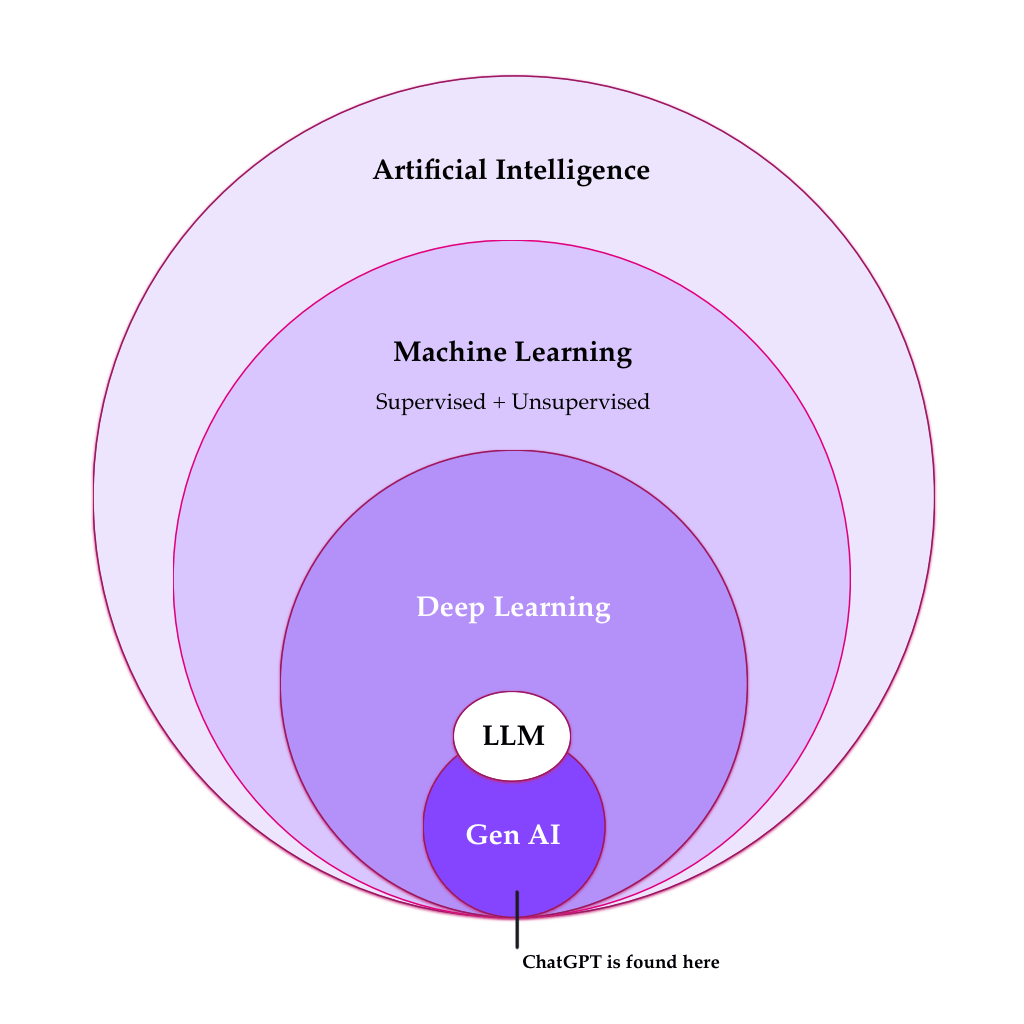
Even though in the media, these terms are often used interchangeably as you can see above, they are not the same and if anything, in simpler terms they came in mostly one after the other as a refinement of the previous technology.
~~~~~~
Sure AI and its different subsets and products will continue evolving blurring the line between man-created and artificially made for years to come to the point where it become extremely or impossible to detect one from the other... (have you seen some of the bleeding edge videos out today? - very impressive, scary or a bit of both ;) )
but today, we stand on the edge of another transformation as it relates to the digital workflow anyways... the age of 'Intelligent' creation...
Let's face it, AI isn't new and its beginning is much like the beginning of "Customer Service AI chatbots", full of promise and quite disappointing yet constantly evolving and doing so quite QUICKLY, 🚀 dizzyingly so even!
What 10-15 years ago felt like an episode of sci-fi: machines writing, designing, or reasoning at a human level, is edging year by year, and even month by month, closer to reality.
There are few things today that can't be done or improved with AI:
draft an article, design a homepage, advise on SEO improvements in seconds, handle multilingual translation, accessibility suggestions, or layout optimization, analyze and suggest code improvements, and so much more! - we even see in 2026, entire programs built by AI with little to no human intervention except the initial request made (they work, don't crash but are yet to be the most optimized or complex) - all things that used to require a specialist or a team of specialists/experts days, weeks or months to build.
Are there negative aspects, often conveniently forgotten or pushed to the side to AI?
I wish I could say no, but that's just not the case... YES there are: overarching data biases and representation gaps, unclear (at best) privacy protection, lack of accessibility, loss of creative authenticity, copyright or trademark infringements, the huge ecological footprint... not to mention the upcoming job displacement, deskilling or re-skilling that will need to happen just to name a few - all in the race for smarter, better, more 'intelligent' tools.
Will these cumulative negative weigh in the balance of humanities' ever accelerating race to some technological utopia: probably not, but thankfully there are those digital heroes who are working on trying to set boundaries, to improve aspects of each of these dangers! kudos to them.
So how will this shape CMSs going forward... and what the future could look like... it all depends, some CMSs are letting external developers leverage AI while other ones are going all-in on AI in their core.
Not sure there is a right or wrong way approach here.
I have already seen a few Joomla! components add AI capabilities to the backend and I'm sure more will come.
If we imagine what it could mean for Joomla!, it could no longer be just a storage and publishing system, it could become a creative partner.
Imagine logging into your site backend and having an AI assistant that goes beyond the current offerings of meta description suggestions or Alt-tag optimization, etc... but one that could understand context, recommend structure, pre-fill content ideas, or analyze user behavior to improve engagement: not as a gimmick, but as a deep integration that learns from your own community’s data. AI could help surface insights that designers, marketers, and developers may not see, blending human intention with machine precision...
I'm not saying this will or should happen, just that this is 1 of many potential directions...
No matter if AI is welcomed or opposed, externalized or brought in to the core it is sure to challenge the status quo and push the boundaries... the years ahead are going to sure be exciting!
Some articles published on the Joomla Community Magazine represent the personal opinion or experience of the Author on the specific topic and might not be aligned to the official position of the Joomla Project
About the author

By accepting you will be accessing a service provided by a third-party external to https://magazine.joomla.org/
Comments