 Community Magazine

When a core component like Weblinks was decoupled, it created a maintenance challenge. My Google Summer of Code project had a clear mission: bring this useful extension up to modern Joomla 5 standards, not just for end-users, but as a public example of high-quality development and testing practices.
Hello Joomlers, I’m Mahmoud Magdy, a third-year student at Ain Shams University in Cairo, Egypt, and a Google Summer of Code 2025 contributor with Joomla. Working on the Weblinks Enhancements project has been a remarkable journey, blending technical challenges, community collaboration, and personal growth. Below, I share my experience, introduce the Weblinks component, and highlight the enhancements I’ve made to make it more powerful and developer-friendly.
What is the Weblinks Component?
The Joomla Weblinks component is an extension that allows users to manage and display external links on their websites. It’s a versatile tool for organizing and sharing resources, such as partner websites, references, or curated lists. For example, a university website could use Weblinks to create a directory of academic resources, categorizing links to research databases, journals, or partner institutions. Users can create, categorize, and display these links in a structured way, with options to customize visibility, access levels, and metadata. It’s worth noting that Weblinks was a core component until Joomla 3.4.0, when it was decoupled.
Weblinks is ideal for:
-
Content Curators: Organize external resources like tutorials or industry blogs.
-
Businesses: Showcase partner or affiliate links in a professional, categorized format.
-
Communities: Share useful links with members, such as event pages or documentation.
The component supports frontend and backend management, allowing administrators to create and edit links while offering frontend submission for users (if enabled). Its flexibility makes it valuable for any site needing to manage external URLs efficiently.
The Weblinks Enhancements Project
My GSoC project focuses on modernizing the Weblinks component to align with Joomla 5 standards, making it more reliable, user-friendly, and maintainable. Beyond fixing bugs and updating code, I aimed to enhance the user experience and help set a standard for extension development. Here’s what’s new from a user’s perspective:
Better Frontend Experience: The frontend form now mirrors the backend, with added “Options” and “Publishing” tabs. Users can configure link settings (e.g., publication dates, metadata) directly from the frontend, making it easier for contributors to submit and manage links without backend access.
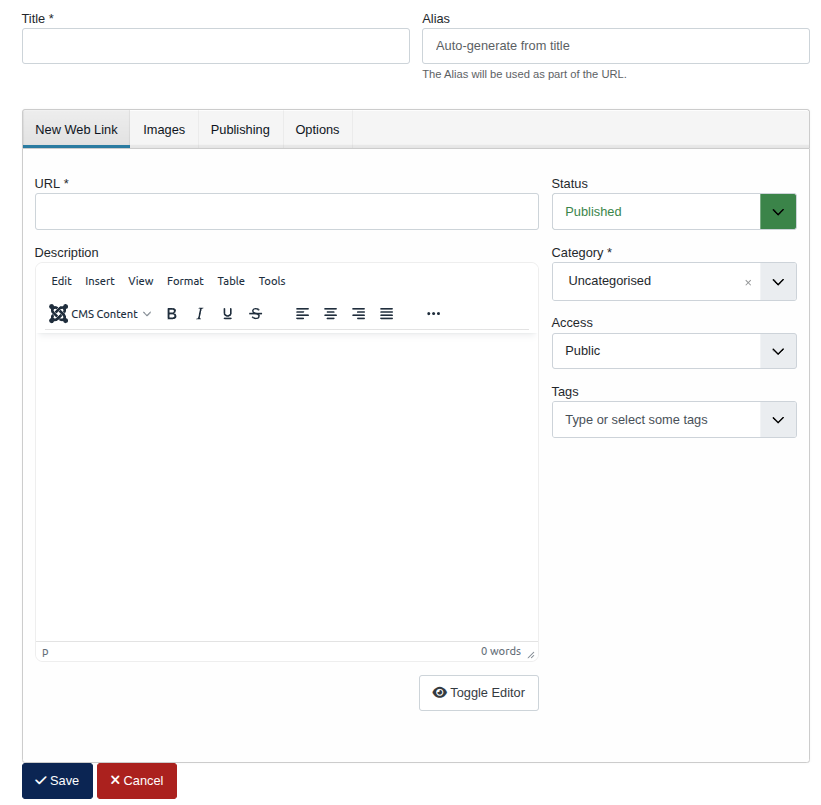
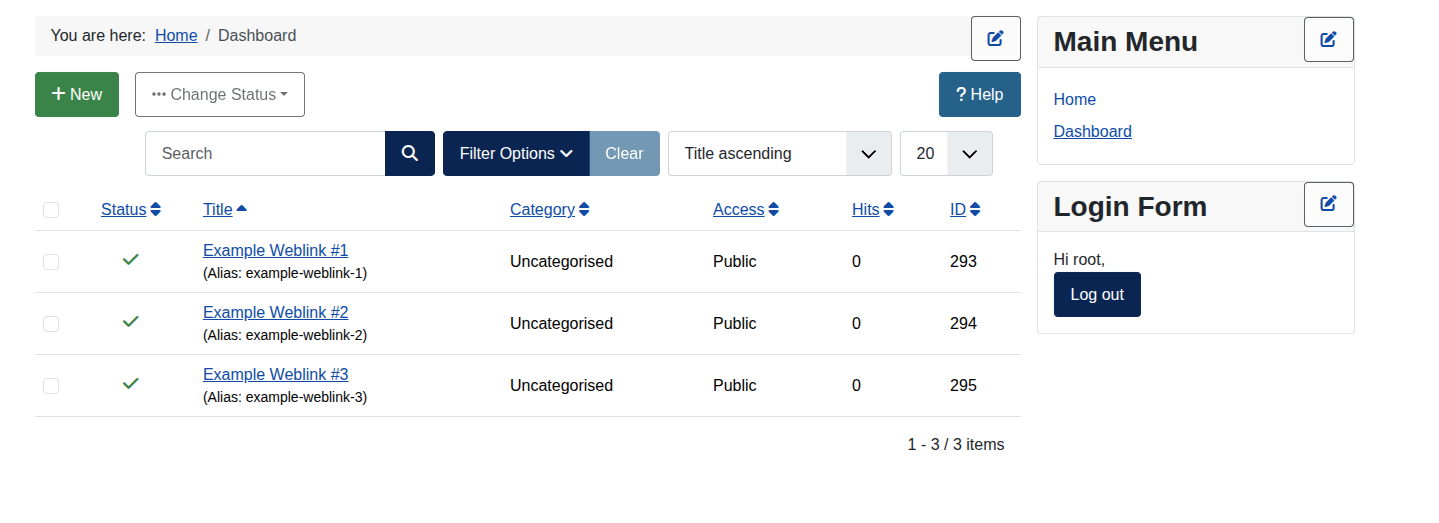
Frontend Dashboard Control: A new frontend dashboard allows users to view and manage Weblinks easily, providing an easy to use interface for controlling links without navigating to the backend.
Nested Category Support: The Weblinks module now supports displaying child categories, with an option to choose the depth of nested levels. For instance, a blog could organize links into categories like “Tutorials > Web Development > CSS” and display them dynamically, improving navigation for site visitors.

GitHub Codespaces Setup: A cloud-based development environment via GitHub Codespaces enables users to test and develop Weblinks effortlessly. With a pre-configured Joomla installation, phpMyAdmin, and XDebug, contributors can manage the database, debug, and test code directly in the browser.
Changelog Functionality: A new changelog feature tracks updates to Weblinks, making it easier for administrators to monitor changes and maintain version history for better transparency and management.

QuickIcon Plugin: Added a QuickIcon plugin to the Joomla dashboard, providing one-click access to Weblinks management, streamlining the workflow for administrators.

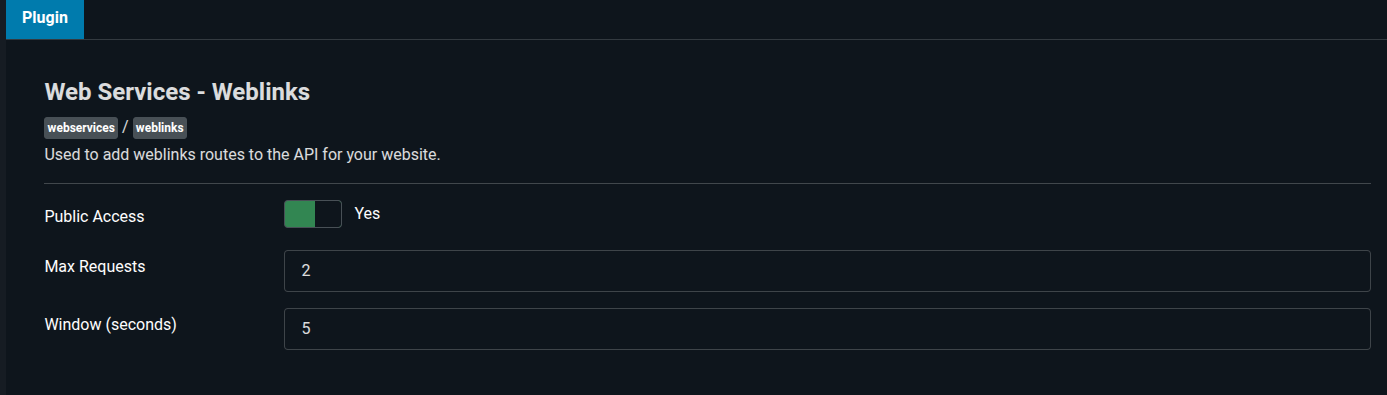
More Robust APIs & API Documentation: Enhanced Webservices APIs with public GET endpoints and rate-limiting options to ensure developers can integrate Weblinks data into other applications securely. For example, a mobile app could pull a list of curated links from a Joomla site using these APIs. To support this, I also built out a comprehensive API documentation to help developers understand the APIs and know what to expect from the APIs responses.
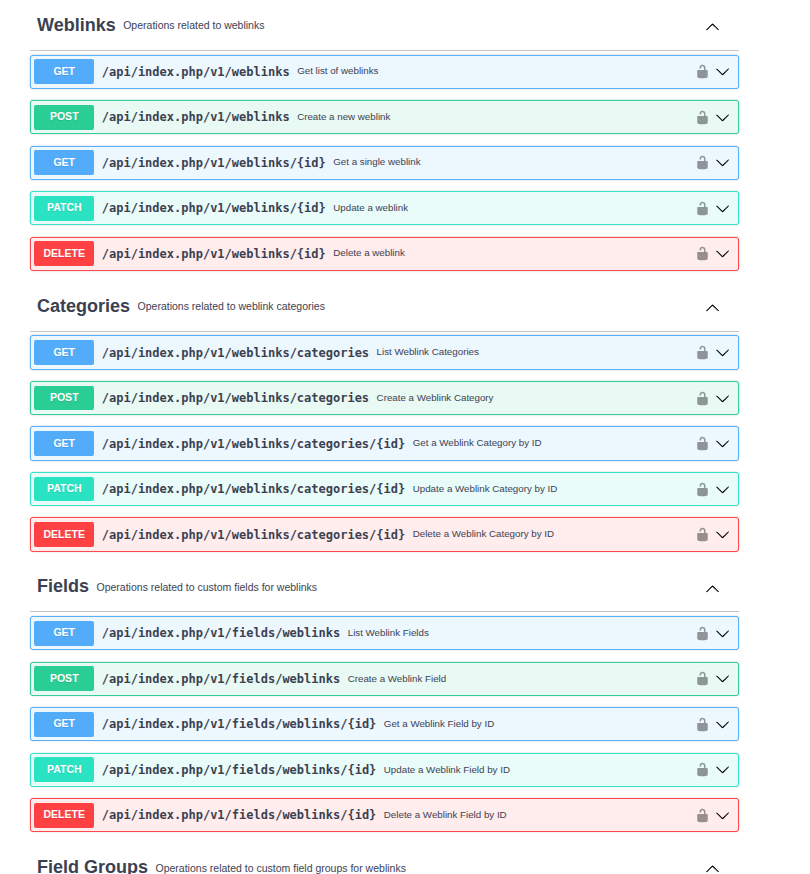
These enhancements make Weblinks more intuitive and helpful for end-users, whether they’re site administrators managing link directories or developers building integrations.
A Model for Extension Development
The Weblinks repository has been designed not only to improve the component but also to serve as an example for other Joomla extension developers. Key takeaways for developers include:
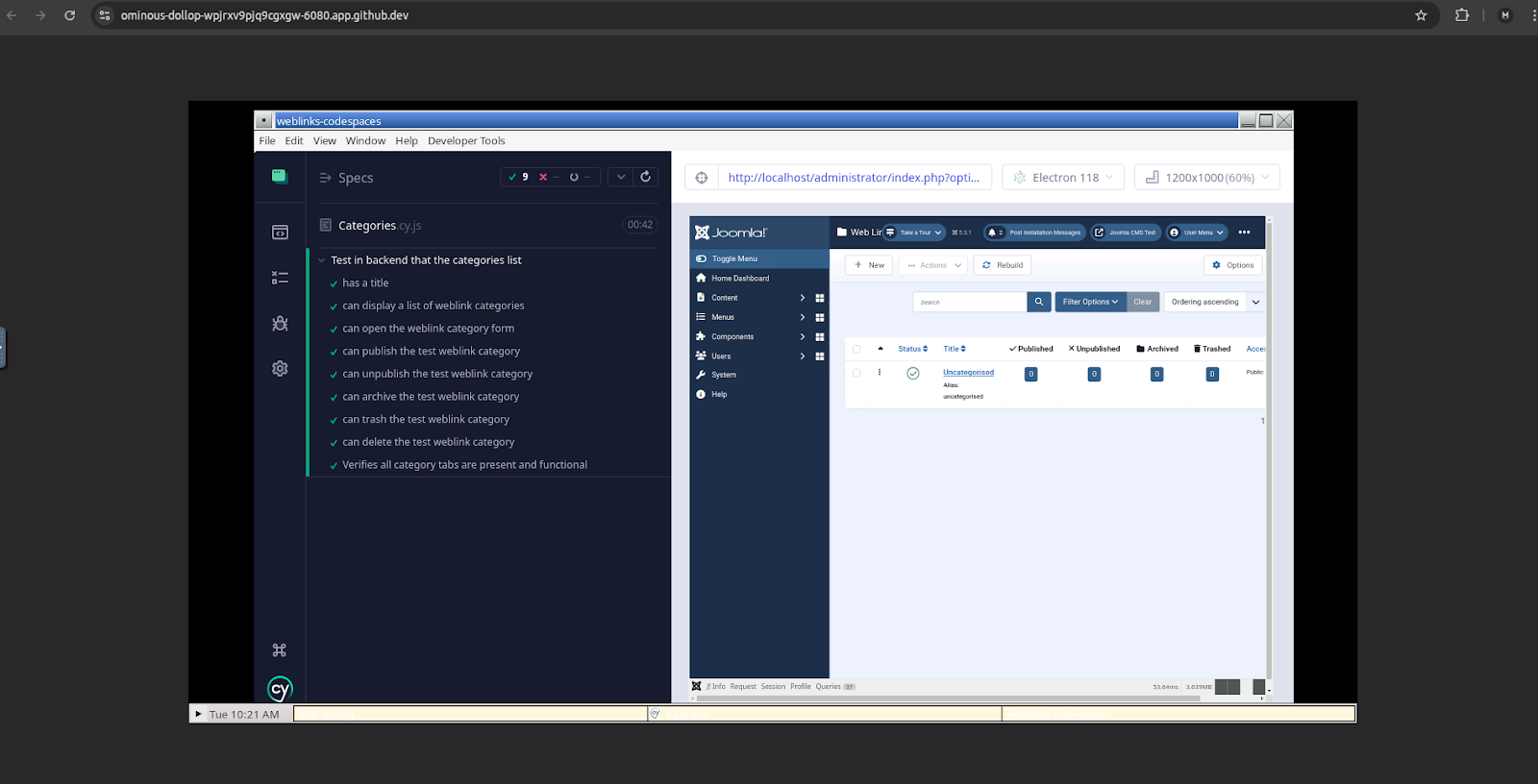
Cypress Testing Suite: I implemented a comprehensive Cypress test suite covering API requests, frontend operations, and module functionality. For example, tests verify that filters for GET requests work correctly and that frontend forms behave consistently. This can help other developers to get an idea on how to write end-to-end tests for their extensions, improving reliability and catching bugs early.
GitHub Codespaces Integration: The repository includes a Codespaces setup, allowing developers to spin up a cloud-based Joomla environment with Weblinks pre-installed. Tools like phpMyAdmin and XDebug are included, making it easier to test and debug code. This setup can inspire developers to adopt similar cloud-based workflows for their projects.
Clear Documentation: The README and in-code comments provide clear guidance on setup, testing, and usage, serving as a template for documenting extensions effectively.
The Weblinks repository encourages other developers to adopt best practices, such as automated testing, ultimately improving the quality of Joomla extensions.
My GSoC Journey: Transformation and Lessons
This project has been an incredible journey, transforming me from a curious student to a confident open-source contributor. When I started, Joomla’s codebase felt overwhelming. My initial contributions, and building simple Joomla components, taught me to navigate this complexity, but GSoC pushed me further.
What Transformed Me?
Early on, I doubted my ability to tackle a project as competitive as GSoC. Writing a detailed proposal and diving into Weblinks’ codebase forced me to confront those fears. Each pull request built my confidence in handling and tackling problems.
Also, Open source was new to me, and I initially was working on solo projects. Working with my mentor, Nicola Galgano, and the Joomla community taught me the power of collaboration. Feedback on pull requests and discussions on Mattermost showed me how to refine my work and align it with community standards.
What Did I Learn?
Technical Skills: I deepened my understanding of Joomla’s MVC framework, Cypress for end-to-end testing, and learned to configure cloud environments like Codespaces. Debugging with XDebug and writing OpenAPI 3.0 documentation were new skills that will stay with me.
Problem-Solving: Fixing issues like child category rendering or URL handling required creative solutions, such as leveraging session storage. These challenges honed my ability to break down complex problems.
Community Impact: What I found most rewarding contributing to Weblinks is knowing that the Weblinks enhancements I developed would directly empower and help users, and that gave my work a clear sense of purpose.
Relevant Links
-
Project Description: https://summerofcode.withgoogle.com/programs/2025/projects/xZ08EQgY
-
Project GSoC Repository: https://github.com/joomla-projects/gsoc25_weblinks
-
Project Main Repository: https://github.com/joomla-extensions/weblinks
-
Weekly Reports: https://volunteers.joomla.org/teams/google-summer-of-code-joomla-team#reports
-
Pull Requests: https://github.com/joomla-projects/gsoc25_weblinks/pulls?q=is%3Apr+is%3Aclosed
Final Thoughts
Contributing to Joomla’s Weblinks has been a journey of growth, collaboration, and impact. The enhanced Weblinks component now offers users a more intuitive way to manage and display links, while its repository sets a standard for extension development. I’m grateful to my mentor, Nicola Galgano, and the Joomla community for their support and encouragement. I invite you to try the updated Weblinks, explore the repository, or join us on Joomla’s Mattermost to share your ideas and contribute to this vibrant community. Looking forward to a future of coding, learning, and making a difference!

Comments