 Community Magazine
In these times, with the rise of e-commerce, having a multi-language website is essential to expand our online business globally. Customers find it more convenient to shop in their language. In many cases, it is also necessary for countries that have more than one official language.
Advantages of having a multi-language website:
- International customers and incursion into new markets: You can have clients from anywhere in the world, and you will be present in any global market.
- Local market: You can be in different regions of the same country and thus attract new customers to your business.
- Competitive differentiator: your business will stand out from your competitors.
- SEO: will improve your positioning by increasing traffic to your site.
Why build your multi-language website with Joomla?
Since its beginning, Joomla has included as a feature the possibility of building multilingual websites. Since version 1.7, it has been possible to construct multilingual sites without having to install third-party extensions and with multi-location. Having a multi-language site implies not only content translation. Several characteristics are entirely different according to the country or the culture, for example, the way of using colors or the fonts (especially for countries with special characters such as Arabic, Chinese, Japanese, Greek, etc.).
There are several reasons why you can and should build your multilingual website with Joomla:
- Joomla has incorporated the multilingual system in its core. You will not need third party extensions to have your website in several languages.
- Joomla is multilingual since its first version 1.7: the project has a long history in developing this feature and makes its code stable and robust at the same time.
- Different languages for the frontend and the backend: you will be able to build and configure your website differentiating between the languages in the backend and the frontend.
- Joomla has 76+ official language packs, so your website can be present anywhere in the world.
- Joomla has multi-location: You can have different sites (template, positions, extensions, etc.) for different languages/countries.
- SEO: Joomla uses a single domain name for all languages, improving the positioning of your website in search engines.
- Multilingual associations (Since version 3.7): When you create an article in different languages, you can associate them and edit both articles side-by-side in the backend. Once published, by switching the language, our website will go to the associated article and not to the home page.
- Complete documentation: How Setup a Multilingual Site
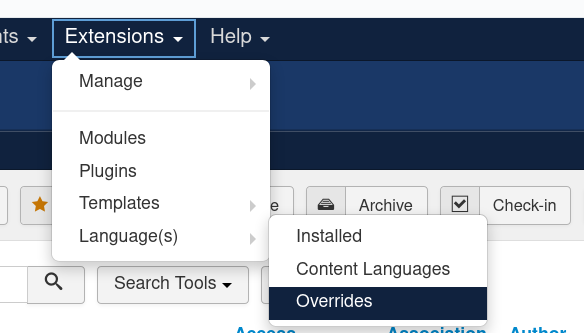
- Overrides: The overrides are modifications for the strings of each language, so from the backend of Joomla you can change each string that is defined in any file of any language, from Extensions > Languages > Override.
All these features make Joomla the ideal CMS to build your multilingual site.
There are also extensions in the Joomla Extensions Directory to implement a multi-lingual website. Still, if it is not imperative to do so, my recommendation is that you always use the multi-language that Joomla has in its core.
Finally, I would like to thank the whole Joomla Community for their effort and dedication, and to Andrea Gentil in particular for her invitation and kindness always.

Comments