 Community Magazine
Joomla and Smartphones
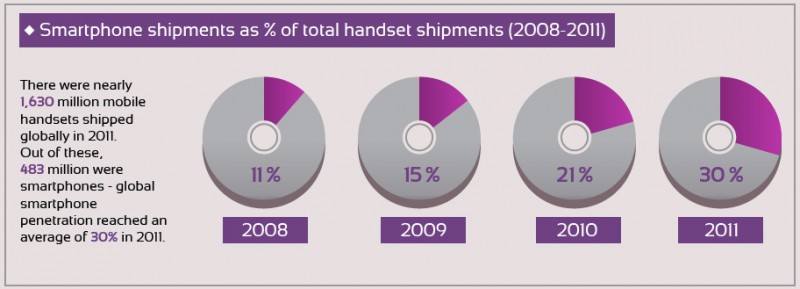
In February 2010 Google adopted a new strategy that the company's focus is now more on smartphones than on desktops. Eric Schmidt summed this up with a new motto: "Mobile First". Google developers started to create versions of new services for smartphones before creating ones to run on PCs. At that time the global smartphone penetration reached a average of 15% (2009). Two years later, we talk about a global smartphone penetration of 30% (2011). Only in 2011, nearly 500 millions smartphones were shipped.
At the Mobile World Congress in Barcelona this week, Google announced:
“There will be an Android in every pocket”
I found no official definition of a smartphone in comparison to other phones (feature phones) but I see three differences
- smartphones are always "on-line"
- smartphones have a browser to surf the web
- smartphones allow applications to have a deep integration with the phone's OS and hardware
The mobile market for feature phones was/is focused on selling ringtones, games and other content brought by the industry to the customer (B2C). The mobile markets (app stores) for smartphones provide the logistic for developers, authors and artists to offer their apps (Digital Distribution Platform).
Mobile Content Management System
An important principle of a content management system (CMS) like Joomla! is the separation of content from presentation. To become a mobile content management system (MCMS) it should have additional features e.g.:
Multi channel content delivery (machine-readable web )
It should be possible to publish XML and an application take this XML and delivers it to mobile devices.
It should be also possible that the mobile application queries the MCMS directly. The MCMS responds with XML that is rendered and displayed by the mobile device. The evolution of this feature went from service-oriented architecture (SOAP, XML-RPC) to resource-oriented architecture (REST).
Specialized templating system (human-readable web)
The templating system is used to deliver the content to the mobile device. Mobile CMS templates must be adapted to a very wide range of target devices with different capacities and limitations.
There are two approaches to adapting templates:
- multi-client: the multi-client approach makes it possible to see all versions of a site at the same domain (e.g. example.com), and templates are presented based on the device client used for viewing.
- multi-site: the multi-site approach displays the mobile site on a targeted sub-domain (mobile.example.com)
Location based content delivery
This feature is important because it did not exist before inside a CMS. Depending on where you are, a MCMS can be used for e.g.
- recommending events in a city
- requesting the nearest business or service, such as a restaurant
- receiving alerts, such as notification of a sale on gas or warning of a traffic jam
- location-based mobile advertising
What is possible in Joomla?
A web content management system (WCMS) like Joomla is affected by this development and will be transformed to a mobile content management system (MCMS) in the future. It needs to be capable to store and deliver content to mobile devices in various ways.
I had a look in the Joomla Extension Directory and asked people via twitter how Joomla fits today in the mobile world.
I want to mention that the examples are not chosen because they are the best or the easiest solution. I just want to give examples. I used a few of them, but not all and I am very interested in your experiences on these topics, so please comment on this article!
Multi Channel content delivery (machine-readable web )
Since the very beginning, Joomla offers the Syndication Feeds module to create xml feeds from content. These feeds can be used by many, many apps e.g. FlipBoard or Google Currents.
Concerning more sophisticated solutions I found the following possibilities for displaying a Joomla site on mobile devices:
Weever apps
You have to install a plugin in your Joomla site, configure and enable it for mobile visitors. The visitor has to access your Joomla site by using a browser on his mobile device and can then add the "app" to his homescreen. It is not necessary and not possible to add the "app" into an "app store". To make it nice and easy for the visitor, you can e.g. use QR Codes.
http://weeverapps.com/home
iJoomer
iJoomer offers an interesting approach. If you need an app, you have to install a component in your Joomla site. Than you can order "your app" by describing your requirements and pay for building it. When ready, iJoomer submits your app to the AppStore and the Android Marketplace. Now you can advertise your app to your clients.
There are free apps available for a connection to JoomSocial. It is possible to use it for mobile commerce together with VirtueMart.
https://www.ijoomer.com/
General management
Another kind of apps are for the general management of your Joomla site. You can write articles, upload photos and more.
joooid
Joooid is an Android client for Joomla: it has been created to publish articles with text, images, galleries and geolocated maps, you can also save drafts for later publishing.
http://www.joooid.com/
JAM! Joomla Admin Mobile!
Another app like this is jAdmin mobile. You can create new articles, set titles and categories, upload images- all without leaving the app.
Specialized templating system (human-readable web)
The templating solutions consists of a template systems which means a mobile template on one hand and a Joomla extension on the other hand. These systems are very powerful and include mobile templates. The mobile templates can be divided by "clean" and "responsive" templates. The clean templates are designed to work additionally to the site template. The responsive templates are usable for a device including the desktop browser.
Separate templates systems
MobileJoomla
Mobile Joomla is a Joomla component and a mobile theme. The component has to be configured inside your Joomla site and afterwards the mobile theme will be displayed to your mobile visitors. You can configure which subdomains shall use which themes and templates in MobileJoomla!

http://www.mobilejoomla.com
Other examples with the same functionalities are
- Apptha Mobile: http://www.apptha.com/category/extension/Joomla/AppthaMobile
- MobStac: http://mobstac.com/
Mobile templates
Most of the template clubs offer their templates either with a mobile version or in general as a responsive template like joomlashine.
Responsive Site Templates
- OneWeb http://internet-inspired.com/blog/css-and-html/one-web-template
- Elastica http://www.joomlart.com/joomla/templates/ja-elastica
- Responsive http://www.joomlabamboo.com/blog/template-news/a-responsive-skeleton-joomla-template
- Basic Twitter Bootstrap http://bootstrap.fastnetwebdesign.co.uk
Responsive Admin Templates
Clean Admin Templates
- Minima http://minimatemplate.com/
Conclusion
It is interesting to see how many different approaches have been chosen to make Joomla an MCMS.
Again, it is not my intention to hightlight the named projects here. I am researching that topic because I am starting to write a book about it :)
For this reason, I want to encourage you again to comment on this article about your experiences, solutions, use cases and examples.
Some articles published on the Joomla Community Magazine represent the personal opinion or experience of the Author on the specific topic and might not be aligned to the official position of the Joomla Project
About the author

By accepting you will be accessing a service provided by a third-party external to https://magazine.joomla.org/
Comments