 Community Magazine


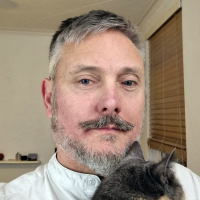
Emmanuel Lemor has just been re-elected Vice President of Open Source Matters. I had that job myself back in 2023, so when the chance came up to sit him down and ask what it is actually like from the inside, I took it rather too quickly.
We talked on a Sunday morning for the best part of an hour. What the Vice President really does when nobody is watching. Where the Joomla Academy has got to. What an Open Source Program Office is, and why a Joomler running client sites should care about one. And whether the arrival of AI website builders ought to be keeping any of us awake at night. His answer to that last one is more interesting than either of the two answers you are expecting.
The ballots closed on 25 August. Ninety-four people were eligible to vote, fifty-one of them did, and Emmanuel came back in with forty-one votes for, six against and four abstentions. Ufuk Avcu and Richard Gosler were re-elected alongside him.
I sent him twenty questions in advance. Here is what came back, follow-ups and all.
A second term
When we last heard from you in the magazine you had only just got your feet under the table, and you said your first job was "learning as much as I can about as many aspects of the organisation". So: what do you know now that you did not know then?
I understand a lot more about the makeup of the teams. How many are active, doing what, and how they interact and fit together. Before, it was very much what is written down in the Volunteers Portal. You can see that somebody is in a department, but you cannot get a sense of how they interact, or what they do to help each other. And that mechanism is the makeup of how things actually progress in Joomla. That, at least to me, was not obvious beforehand.
You also said you hoped to be able to say that you had, and I am quoting you here, "in my small way, helped Joomla and the community". One term down. By your own measure, did you?
I would like to hope so. Being involved in a lot of teams gives me a bit more of a thirty thousand feet view of everything. One of the things that is challenging, at least as I feel it, is communication. By being in those teams I was able to get that touching point across different departments and different areas. Sometimes passing information along, sometimes lifting up people who were going through a difficult time.
I hope, and I feel to some extent, that I have been able to help Joomla and its community. I do not know how large that extent is. I wish of course it was more. That is always the goal.
I will say this from my own side of the fence, having watched him do it: he has put a lot of effort in. He is not a silent Vice President, and he is certainly not a standing back one. He has been in the meetings, with the teams, doing the work.
Inward and outward: what the job actually is
When I had the job in 2023 I described it like this. The President is the outward face of Joomla, all the meeting and greeting and pushing the brand at the world, and the Vice President is there to take up the slack and add a bit of focus, head down in the community, listening and feeding it back. Three years on, do you recognise that? Is it still how it works?
In part it has changed, and in part it is very much still that. We have had several presidents since your time, and I think it also has to do with each president. Different presidents have had different views of how Joomla works, and I tried to adapt so that not too many things were disruptive to the community, or missing. With certain presidents I took on a more outward-facing position, going to FOSDEM and so on, in part because between ourselves we decided I had the experience or the connections for it.
The idea is to support the President and the board, so you do what is needed to help in the ways you can. That is something I have kept in the back of my head. It really does change from president to president.
Now, your manifesto is full of outward-facing work: the Open Web Alliance, FOSDEM, United Nations Open Source Week, corporate partnerships. On my description, that is the President's half of the job. So has the role changed under you, or have you changed it on purpose?
I do not think that change comes from me particularly. I have adapted to the needs of the board and of the presidents we have worked with. My way of thinking, whether it is right or wrong, is that you should play to each of our strengths and abilities. I have made connections with people outside the Joomla community, and we want to foster those connections, because that is for the benefit of Joomla going forward. So has it changed? Yes, in some way and it has also stayed the same in other ways. Most important is it feels very collaborative, and it feels done together.
There is a practical side to this that people forget. The President has holidays, family, and sometimes health to deal with. The Vice President is literally there to become the spokesperson when the President cannot be. That alone can make the job a good deal more outward-facing than the job description suggests.
Emmanuel put it more bluntly than I would have: "In my case, sadly, I do not have a family, so I am relatively more available."
And if the Vice President is looking outward, who is looking inward? The encouraging of teams, the quiet unblocking, the making sure things actually run. And by quiet unblocking I mean the thing you can only do when you can see the whole picture: having a word with somebody who is holding something up, on behalf of somebody who does not even know which lever is being pushed.
Yes, exactly. Maybe not in every area of Joomla, but I have definitely done some of that. In at least one department I have supported a lot of that kind of activity, keeping people motivated and stopping people from ending their volunteering altogether. I think that is truly an important part of the role, because volunteering is not easy.
What happens when you and the President disagree?
We talk about it as a board. We have not had those direct conflicts of pitting one against the other. On the couple of occasions we have disagreed, and we should be able to disagree as a board, we should discuss things and we should have different opinions, talking it through as a board has helped us get on the same page.
The Joomla Academy
Fair warning before this section. This one is my baby, so do tell me if you think I am being precious about it. I was genuinely curious rather than checking up on him.
The Academy. I started it on the assumption that each Vice President would pick it up and push it further than the last one did, because the Vice President role felt like the right place for it. It is an internal thing, but it is an encouragement thing too, and I had seen how far encouragement from a senior officer can pull people along. So: where has it got to?
The Academy has found some very good students this cycle. Adarsh Dubey has done a really good job, and his project is about to be wrapped up and finished in the next few weeks. The mentors, official and unofficial, have really been there to support the student in a positive and collaborative way. I have stepped into a few meetings just to be there and encourage, and behind the scenes I am always checking in to see if he needs anything.
The projects themselves are genuinely valuable. Making the back end more responsive, and autosave. I am not saying I am right, but those are features I have wanted in Joomla for years. I hope the community will see them the way I do, which is: oh, thank goodness, this makes my life easier. That is the enthusiasm Adarsh has for them.
He came and spoke at Joomla London, and it went down extremely well. A very interesting talk.
I know there is a cohort running at the moment, and I gather the Academy is also being kept in reserve alongside Google Summer of Code (GSoC), so that if a GSoC place does not come our way the Academy can step in. Is that how you see the two of them fitting together?
Yes, and that is exactly what happened this year. Normally it is up to four projects. Google Summer of Code got three. The remaining slot, for which we already had a project roughly defined, is where the Joomla Academy stepped in and found a great student and great mentors. And if in a future year we do not have Google Summer of Code, I hope to see the Joomla Academy replace it for Joomla.
That is exactly how I originally envisaged it. It came out of a barren year when we did not get a Google Summer of Code place at all, and it seemed to me that we badly needed that constant stream of young people coming in. I put money behind it myself, and I would again if it needed topping up. It is not only about the code. It is about the community, and some very good people have come to us that way.
That first cohort produced the enhanced search engine optimisation work and the advanced migration tools. Where has all that ended up? I would like to be able to tell readers what became of it, because the students put a great deal into it.
I only have partial information to share. I know about the search engine optimisation work. I know there is still work being done on the WordPress to Joomla migration toolset, but due to not enough volunteers in every area, priorities move as needed to push the project forward. It is still there and it is still moving forward, just not at the same pace. Which is actually how I see the Academy helping: you get that focused attention and focused energy that moves things forward faster.
Worth saying, and this is a view I found that we shared: several things now sitting in Joomla core took multiple Google Summer of Code projects to get there. The first one asked whether it could be done. The second asked whether it could be made good enough. The third got it to the standard international software actually needs. So work not landing in core straight away does not mean it was wasted. It does mean somebody has to pick it up, and that is something we should look at.
And here is the one I would most like a straight answer to, though I promised to be gentle about it. Should the Academy eventually become a permanent Open Source Matters programme with a budget line of its own, so that it does not depend on whichever Vice President happens to have taken a shine to it?
Yes. To be honest, that is how I treat it in my head anyway, and I think that is what it should be. It is a valuable programme in its own right. And if I may be so bold, the other content management systems out there have their own. It is not unique to us.
It is not, no. We borrowed heavily from the others when we built it, and both Drupal and TYPO3 have rather more going on in that area than we do.
So for me it should not be an accidental "oh, let us do it again maybe this time". It should be a permanent fixture.
Money and partnerships
You have restarted the Capital Team. Why had it stopped, and what is different this time?
There are a few reasons. Speaking to some of the past members, there was a previous president who had a particular way of looking at the Capital Team and its work that did not sit well with the team members at the time. And I think there was an element of wanting to do too much at once, so nothing had a single priority.
The current Capital Team is focused on one priority with two sub-priorities, which are the two places to go and find the money: Open Source Program Offices, and corporate entities. There are hundreds of thousands, if not millions, of companies using Joomla that are not giving back in any way at all. Not time, not money, not resources. Nothing.
To be clear, that is not just a Joomla problem. It is a fundamental problem for every open source project, and it was heavily discussed at United Nations Open Source Week. The UN is trying to come up with ideas at its own level that it hopes will be adopted downstream.
Open Source Program Offices. Explain that to a Joomler who has never heard the phrase, and tell them what one would actually mean for them.
An Open Source Program Office has been around as an idea for more than ten years, but it did not really pick up steam until the few years, when organisations, governments and companies started to realise how much they rely on Open Source software.
The number I have quoted before is that 92 percent of what the world uses day to day (from a digital point of view) relies in some way on one or more open source projects. And on the numbers from FOSDEM, in a talk by the founder of the curl project, at most 2 per cent of open source projects were getting any outside support. The gap between 92 and 2 is a big and real problem.
These offices are found in academia, in corporations and in government. They are partly an evangelising unit and partly a structuring unit, making sure open source activity is handled in an organised way. But mostly they are a signal to the organisation that there is one central point of coordination for everything open source. Some have funding capabilities, some do not, but they are always an entry point for information and for contact into a much larger organisation.
I have recently been trying to instigate the creation of such an office at a major United States university that did not have one. The more of them there are, the more recognition there is for the work open source does, and that is where giving back begins. If you do not know something exists, you do not give back to it. You do not pay attention to it, because you simply do not know.
What is the ask of a company that has built its whole business on Joomla and never given back a penny or an hour? And what do we do when they say no?
The ask is flexible, because several mechanisms already exist.
There is the Open Source Pledge, an existing framework where a company gives 2,000 euros or dollars a year to an open source project of its choice. Ideally, obviously, Joomla.
If a company cannot do that, because of its size or its circumstances, there is the Open Source Employer Pledge. That is where an employer says: we rely on Joomla, we cannot give money, but we have people's time. So they let some of their marketers, coders or documenters give X hours a week, or two hours a month, or sixteen hours a month, on company pay, dedicated to the project.
And if neither of those works, they can sponsor Pizza, Bugs and Fun. That costs around 500 euros a year, or 250 euros a session, and can be sponsored a session at a time or several years at a time. Those are much more reasonable numbers. There are other sponsorships and partnerships we can discuss too. We are quite flexible.
As for a no: you get far more noes than yeses at the moment. We thank them for listening and we keep them on the list for the future. We have never had a "get out of my face and never contact me again" sort of no. They are far more "it does not fit our priorities right now", or "we do not have the money". So we go back to them later and hope things have changed.
If a company does give, say, the 2,000 pledge, is that recognised by governments? Can they claim it against tax?
That varies enormously by jurisdiction and by country. At this point it is not universally recognised, sadly. That is also part of what the UN is trying to solve. There has even been talk of a half a percent levy on larger corporations to create a pool of money that projects like Joomla could draw on. That is still at the talking stage. Nothing has been ratified or decided.
But that is why Joomla and the board take part in things like Open Source Week and FOSDEM: to make sure we are in the conversation. If we are not in the conversation, we live through the decisions of others, and that is much harder and not a great thing.
Look at what happened with the Cyber Resilience Act, the European Union act to strengthen cybersecurity. Open source was forgotten in the drafting. A group of people from the open source community got behind it and rattled the cages, and said: hello, we’re here! we exist! We are 92 per cent of the infrastructure over here, do not forget us. Had they not done that, the requirements the act would have placed on open source projects would have been catastrophically heavy.
I sat through several of those early meetings myself. Thanks to that work we are part of the conversation, and we need to be part of it for the European Union AI Act and everything else coming down the pipeline. These are big tankers and they take a long time to turn. You have to get in early and make your voice heard. It is no good turning up at the end when the decisions are made, because it is much harder to reverse a tanker than it is to change its course.
Emmanuel is heading to the Open Source Congress in Halifax on the same reasoning.
One thing he mentioned that I had not heard about, and which I think deserves more daylight than it gets: the board now has a policy that before anyone attends a conference, there is a document setting out what the event is, what we are trying to achieve there, and what the nice-to-haves are. Afterwards there is a report on how it went and what was achieved, plus a shared contacts list so the connections are not lost. That did not exist when he took the role on. It is exactly the sort of quiet, unglamorous fix that never makes the news.
On boards generally, he made a point I liked: running a board is not knowledge you are born with. Nobody wakes up at twenty-five knowing how to do it, and every board is different. The composition of this one is quite different from the board of eighteen months ago, which was very different again from the one I sat on or the other boards he participates on. You adapt to its members, to the personalities, and to the technological moment you happen to be in. That last one you cannot change at all.
AI, and what it does to a CMS
A confession before this bit. I had some help pulling these questions together, from precisely the sort of thing we are about to discuss. It has been impeccably behaved so far, and it has also quietly written itself into the interview. So take the next three as coming from both of us, and assume it is listening.
My AI wanted me to open this section with something dramatic. I have overruled it. Your manifesto names "nascent AI website generation solutions" among the pressures on Joomla, so, plainly: how worried should we be?
I look at the web as a constantly evolving child. And there are children out there who think they know best, and think it very early. That is what I would say the previous and current generation of AI site builders are.
I have tested more than fifteen of them. If you want a simple three or four page presentation site, a shop window with no interaction with the outside world, they can do the job. I would not say it is as fast as they claim. Some of the models say sixty seconds; it might take you a few hours once you have tweaked the first generation and gone round again.
But here is the thing to recognise. This is roughly six months of the AI companies focusing on this kind of work. If the business world keeps pointing that level of resource at it for, say, five years, it is going to be a very different picture.
Do I think Drupal, WordPress, Joomla and TYPO3 are threatened by AI in this area? Absolutely, if we do not recognise that it is even there. If you do not recognise something is there, you are going to get an awakening, and sooner than you think. Even the largest open source content management system has seen its market share decline. I am not saying AI is the only cause. There are other reasons. But AI is part of it.
AI is getting smarter and more capable. With Model Context Protocol servers and other tooling there is more and more interconnection possible, application programming interfaces (APIs) are everywhere, and the models can connect to them fairly easily now. The design tools are getting impressive. Even accessibility, which you could once say the AI builders had ignored, is now in the picture. Piece by piece it all gets taken care of.
Does that mean content management systems are doomed? No, I do not think so. There will always be a place for where Joomla sits. I just do not know how large that place will be. The systems Joomla is good at are the ones sitting on a university campus connecting to a dozen departments, or a corporate portal talking to legacy systems. Those are places where it would be difficult to trust an AI to rip out the current system and drop in a generated one.
But I am realistic. I look at my own clients and I think perhaps 20 per cent of the sites I have built could be built and maintained by an AI in the future, whether I like it or not. And then right now I have a new customer whose booking system talks to three different interfaces and two different systems, and AI would have real difficulty with that, at least for the next few years. So I think we have a real place, and a real role.
What is Joomla's honest answer to somebody who says "I will just get an AI to build it"?
Good luck with that. At least today.
I do not have a crystal ball and I do not know what it looks like in five years, but I am confident that for the coming years there is a very real place for Joomla.
And I would add one more thing: the more willing we are to open Joomla up to be AI compatible, the better it will be for Joomla. I remember very vividly, as Vice President, some people in the greater community were quite against AI, no, we refuse AI. It has not even been a year, and now almost everybody is coding with it, using it daily. It creates challenges, but I doubt the world is going back.
This one my assistant wrote itself, which I thought was fair enough coming from it. Where should Joomla be spending its AI effort: in the product, or in how we build and maintain the product?
That is a very controversial question, Mr Interviewer. ;)
Both. It is about priority.
Taking the second half first, how we build and maintain the product: we can say we should not code with AI, and we should not use it to look for security flaws, but we would be fooling ourselves. AI is here to stay whether we like it or not, and it is better to go with it than resist it. It is about how we frame it. If we frame it as accepting people who are assisted by AI but who understand the code and how it affects Joomla, then it is positive.
Where it becomes dangerous is when somebody like me, who does not code very well at all, goes to an AI and says "make me a component for Joomla", knowing none of the things they are supposed to know, and then very proudly installs it. It works, by some kind of magic. Of course it follows few if none of the standards, and it is not accessible. But they feel proud, because they have a component. That is dangerous, and we need to draw a line somewhere before that.
As for the product itself, there are already solutions out there. I tested a new one only yesterday. They sit in the back end as an assistant, guiding you on search engine optimisation, or on the security settings you are meant to have got right, somewhere between a health checker and a full security tool.
Personally I do not see a problem with that, as long as it is secure, as long as it does not slow your site down, and as long as it is accessible. I am not saying it belongs in core, let us be clear, that is a whole other debate. But if you manage fifty sites and you want a tool that goes in and checks all the things you are supposed to have checked, it will do it far faster than you will. Yes, it might make mistakes. So do humans. At the very least it remembers the things you forget, and depending on the sites you build there can be an awful lot of settings to check.
That is me, though. Other people will have different opinions.
The community
Ninety-four people were eligible to vote in your election, and fifty-one of them did. Does either of those numbers tell you something we ought to be doing something about?
The ninety-four is positive, even though it is nowhere near big enough. Slightly positive, because that is more people than we had at the previous election. So it seems the collective effort to get more people into Joomla and onto teams is working, on a small scale at least. It could always be much higher.
As for the fifty-one who voted, that is something I have wondered about for a long time. Why do people not vote? I do not know whether the email lands in spam and they never see it. I do not know whether people are simply too busy, and we always have to remember that Joomla is a volunteer organisation where people donate their time, and we have to respect that. But it would be nice to have more of the voting body actually voting.
For what it is worth, I think spam does play a part. I have certainly had to go hunting through my own folders thinking I really ought to have something to vote on by now.
When I was in the role the sore spot was the culture on GitHub. Is that better, worse, or has it just moved somewhere else?
The sore spot moves from generation to generation. I remember a time when the forum was the place. That has quietened down, with the occasional reminder that it is still there. Then for a good while it was GitHub. I do not know whether this is a consequence of AI or not, but that does not seem to be as much of an issue now.
My own reading is that it will always swirl around wherever the personalities are, and at the moment that is in teams rather than in public pull requests. It is good that GitHub has gone quieter. It is worth being honest that quieter in one place usually means louder somewhere else, and that where you stand on any of it depends a great deal on whose point of view you are looking from. In a community this large, that is the problem.
To finish
At the end of this term, what should we be able to hold you to? Something specific enough that somebody could actually go and check.
That I will have been genuinely effective in restarting the Capital Team, and will have brought in sponsorships or partnerships that help the financial health of Joomla.
And is there anything else you would like to say to the community?
Humm , thinking… a World Conference is coming?
Yes, thanks. For anybody who has not bought a ticket yet, you need to get yourself to Potsdam in October, because we have not had a Joomla World Conference in quite a while. The 16th to the 18th of October 2026. Everybody who is enthusiastic about open source and about Joomla will be there, to connect in person, to hear great speakers, and to find out about things coming in Joomla and solutions you did not know existed.
See you there.
My thanks to Emmanuel for an hour of his Sunday and for answering everything I put to him, including the ones he could reasonably have ducked. Congratulations on the second term.
If you have a view on any of this, and particularly on whether the Joomla Academy should become a permanent programme with a budget line of its own, the magazine takes comments, the forums are open, there is a Mattermost channel with the door propped open and Emmanuel’s virtual door (Direct Messages on Mattermost) is waiting for you. As Emmanuel says, the things that get decided are decided by whoever turns up.
And do get your ticket for Potsdam!
Comments